
Five Fitness Tests After 50: What They Really Show and What to Train Next
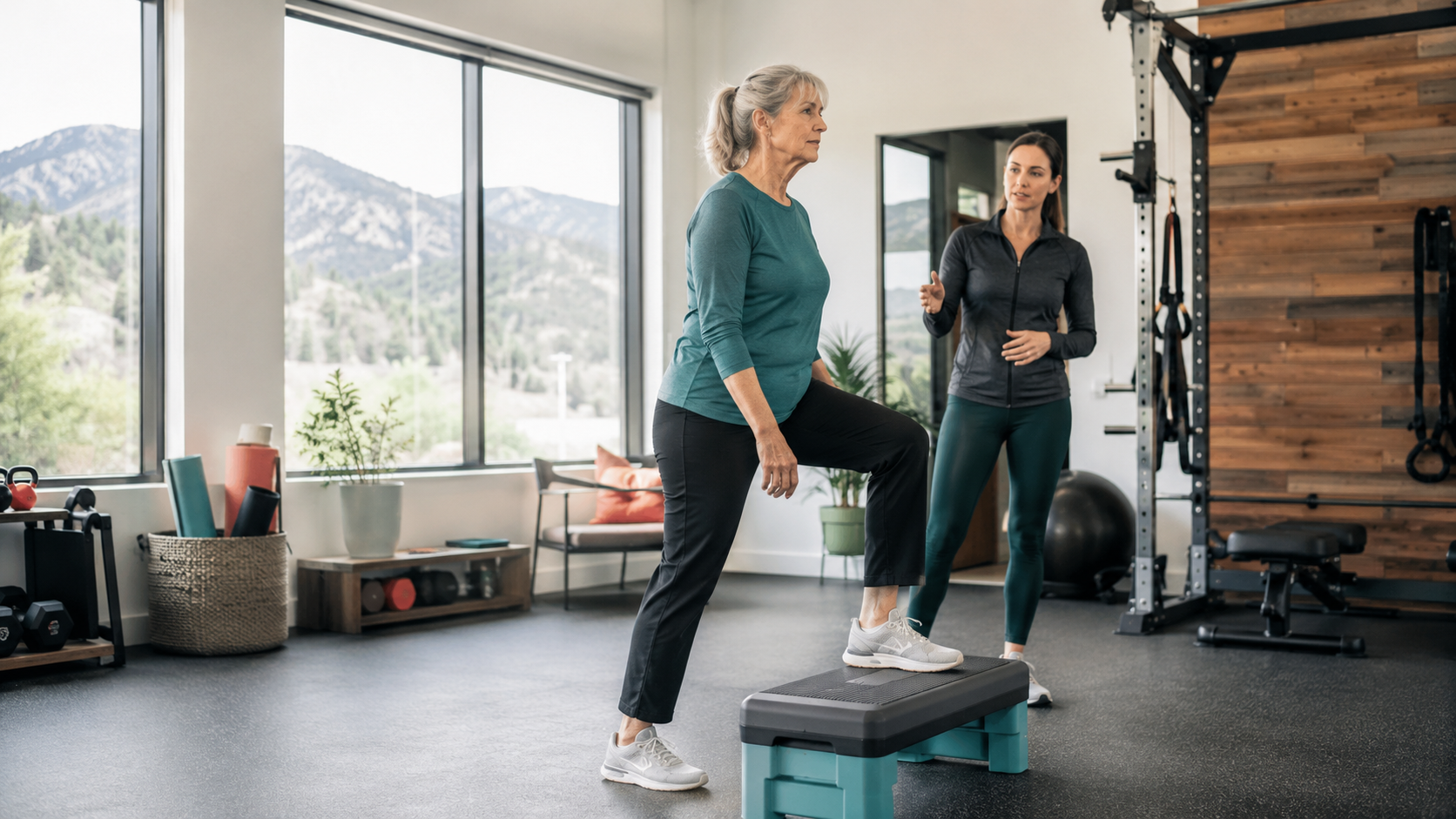
Five Fitness Tests After 50: What They Really Show and What to Train Next
Longevity fitness tests are everywhere right now: hold a deep squat, stand up from the floor without your hands, hang from a bar, carry a certain percentage of your body weight. They are appealing because they promise a simple answer to a complicated question: Am I aging well?
Here is the more useful answer: no single exercise can predict how long you will live. A good fitness benchmark can show how you perform today in one area, such as leg strength, balance or conditioning. Repeating it under similar conditions can also show whether your training is working.
That makes the best test less like a verdict and more like a compass. If a check exposes a weak link, you have something specific to train.
The Quick Answer
Useful fitness tests after 50 should be safe, repeatable and connected to real life. Five practical areas to check are chair-stand capacity, supported balance, step-up control, carrying strength and brisk-walking capacity. Record a starting point, train the limiting quality and retest in four to six weeks. Pain, dizziness, a recent fall, or a significant health condition is a reason to pause and seek appropriate professional guidance, not push harder for a score.
Why Fitness Benchmarks After 50 Are Having a Moment
A fresh wave of consumer coverage has put so-called longevity tests back in the spotlight. At the same time, the American College of Sports Medicine ranked fitness programs for older adults as the number-two fitness trend for 2026, emphasizing balance, muscle mass, strength and mobility.
The broader interest makes sense. Most people are not training for a medal. They want to keep hiking, ski with their family, handle stairs, travel, garden, carry groceries and get up from the ground with confidence. Around Arvada and Golden, fitness often supports a life lived outside the gym.
Research supports paying attention to physical capability, with an important caveat. A systematic review found that grip strength, walking speed, chair-rise performance and standing balance were associated with all-cause mortality in older community-dwelling populations. Those are population-level associations, not personal expiration dates. They can help identify areas worth improving; they cannot tell one person how long they will live.
Five Fitness Tests That Can Guide Your Training
Do these checks when you feel rested and in a clear, uncluttered space. Use stable support when noted. The goal is a calm baseline, not a maximum-effort highlight reel.
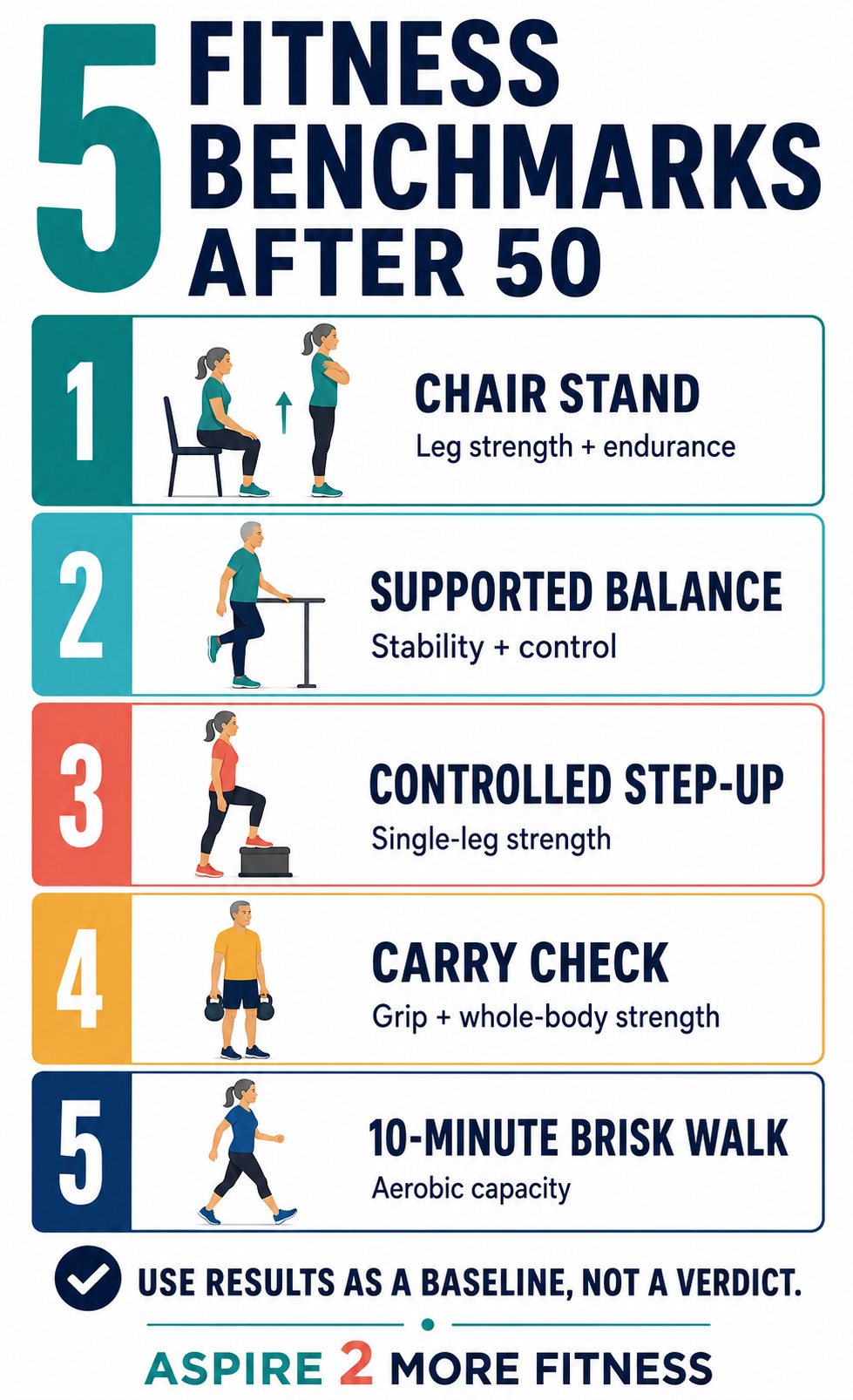
1. The 30-Second Chair Stand
What it checks: Lower-body strength and muscular endurance.
Place a sturdy, straight-backed chair against a wall. Sit near the middle with your feet flat. If it is safe and comfortable, cross your arms over your chest. Stand fully and sit with control as many times as you can in 30 seconds. Have someone nearby if you are unsure about your balance.
The CDC uses the 30-second chair stand in its STEADI fall-risk resources for older adults. Its age-based scoring begins at 60, so someone younger should not borrow those clinical cutoffs and treat them as a diagnosis. Your clean, repeatable count is most useful as a baseline.
What to train next: Squat variations to an appropriate depth, sit-to-stands, leg presses and progressive resistance. If you must rock forward, collapse into the chair or use momentum, the movement quality matters as much as the number.
2. A Supported Balance Progression
What it checks: Static balance and your ability to control a narrowing base of support.
Stand next to a counter or other stable surface. Progress only while you feel secure: feet side by side, one foot slightly ahead, heel-to-toe, then a brief single-leg stand. Aim for up to 10 calm seconds at each stage with eyes open. Keep a hand close to support and stop before you lose control.
This is deliberately less dramatic than closing your eyes on one leg for social media. The CDC's four-stage balance assessment uses progressively narrower positions and 10-second holds because balance is a skill that can be observed and trained without adding unnecessary risk.
What to train next: Supported single-leg work, calf raises, step-ups, controlled direction changes and strength exercises that challenge the hips and trunk. A large right-to-left difference is useful information for programming, not proof that something is 'wrong.'
3. The Controlled Step-Up
What it checks: Single-leg strength, coordination and control during a task that resembles stairs, trail steps and climbing onto a curb.
Use a low, stable step beside a railing or support. Step up, stand tall without pushing off hard from the trailing foot, then lower slowly. Try several controlled repetitions on each side. Note whether one side feels less stable, whether your knee drifts inward, or whether you have to rush the lowering phase.
This is a coaching benchmark rather than a medical screening test, so there is no universal pass number. Step height, limb length, training history and joint tolerance all change the task. Consistent setup and smooth repetitions are more meaningful than comparing yourself with a stranger.
What to train next: Split squats, supported step-ups, hip-strength work and slower lowering phases. Build height or load only after control is reliable.
4. The Carry Check
What it checks: Grip, upper-back strength, trunk control and the ability to move with an external load.
Choose two manageable dumbbells, kettlebells or evenly loaded bags. Stand tall, keep your breathing steady and walk for 20 to 30 seconds without leaning, shrugging or letting the weights swing. Set them down with the same control you used to pick them up.
Skip the viral rule that everyone should carry a fixed percentage of body weight. Body size, hand size, equipment, experience and orthopedic history all affect the result. A sensible starting load that you can progress is far more useful than a heroic one-time attempt.
What to train next: Rows, loaded carries, deadlift or hinge patterns at an appropriate level, and direct grip work when needed. Carrying strength has an obvious payoff for groceries, luggage, yard work and recreational gear.
5. The 10-Minute Brisk Walk
What it checks: Sustainable aerobic effort, pacing and recovery.
On a familiar, mostly level route, walk briskly for 10 minutes. Record the distance or route, your effort on a 1-to-10 scale and how quickly your breathing settles afterward. You should be working, but not racing. If you cannot speak a short sentence, ease the pace.
The federal activity guideline for adults is at least 150 minutes of moderate-intensity aerobic activity each week, plus muscle-strengthening activity on two or more days. A 10-minute check does not measure all of cardiovascular fitness, but it creates an accessible baseline for gradually adding pace, hills or duration.
What to train next: Regular walks, short incline intervals, cycling or another tolerable aerobic activity. Progress one variable at a time rather than making every session longer, steeper and faster at once.
What These Tests Do Not Tell You
- They do not diagnose an injury, arthritis, a neurological condition or a heart problem.
- They do not prove that one person will live longer than another.
- They do not measure every important quality. Power, mobility, reaction time, technique, confidence and training history also matter.
- They do not require you to chase a universal number. The most useful comparison is often you versus your own prior result under similar conditions.
Turn a Result Into a Four-to-Six-Week Training Block
Start with the lowest-scoring or least-confident area that matters to your life. Then train it two or three times per week in a way you can recover from. A simple plan might pair two full-body strength days with regular aerobic work and brief balance practice.
- Choose one primary benchmark and one supporting benchmark.
- Select exercises that train the underlying quality, not just the test itself.
- Progress gradually by improving control, repetitions, load, range or duration.
- Retest under the same conditions after four to six weeks.
- Keep what improved; adjust what did not.
This is where individualized coaching can save time. A low chair-stand score could reflect strength, confidence, technique, fatigue or an unsuitable chair height. The number starts the conversation; it does not finish the assessment.
When to Get More Guidance
Stop a test if it causes pain, dizziness, chest pressure, unusual shortness of breath or a sense that you may fall. Talk with a qualified medical professional before testing or changing your exercise routine if you have a recent injury or surgery, unexplained symptoms, repeated falls, or a health condition that affects safe exercise.
A personal trainer can help when the main challenge is choosing appropriate exercises, learning technique, progressing resistance, building consistency or adapting a program around your current abilities. Medical diagnosis and rehabilitation belong with the appropriate licensed healthcare professional.
Build a Better Baseline With Aspire 2 More Fitness
If these checks revealed a gap, that is useful news. You now have a starting point.
Aspire 2 More Fitness offers customized in-person personal training at The Sweat Garage in Arvada and The Training Spot near Golden, along with virtual coaching. Justin Kraft is a NASM Certified Personal Trainer, Performance Enhancement Specialist and Corrective Exercise Specialist. Your program can be built around the capacities that matter to you, whether that means stronger trail legs, steadier balance, better conditioning or more confidence with everyday movement.
Schedule a free assessment to establish a clear baseline and turn it into a practical plan: aspire2morefitness.com/contact
Frequently Asked Questions
What fitness tests should I be able to do after 50?
There is no single mandatory list. Useful benchmarks cover lower-body strength, balance, single-leg control, carrying strength and aerobic capacity. Choose tests that are safe for you, record a baseline and focus on improvement rather than a universal pass score.
Are longevity fitness tests accurate?
Some measures of physical capability are associated with health outcomes in population research, especially among older adults. That does not make a single home test a lifespan predictor. Treat the result as one piece of information about current function.
How often should I retest?
Every four to six weeks is often enough to see whether a focused training block is moving in the right direction without turning every workout into a test. Use the same setup and similar conditions each time.
Can I improve strength and balance after 50?
Yes. Strength, balance and conditioning remain trainable later in life. The best starting level and rate of progression depend on your current abilities, exercise history and health considerations.
When should I hire a personal trainer?
Consider a trainer when you want a structured assessment, help with form, personalized progressions, accountability or a program linked to a specific activity. Seek medical evaluation first for unexplained pain, dizziness, repeated falls or other concerning symptoms.


