
Resources / Article
How to Build Muscle After 40 A Practical Strength Guide

Yes, you can build muscle after 40. The most reliable approach is consistent resistance training, enough weekly work, gradual progression, and recovery that supports the work you are asking your body to do.
Turning 40 does not close the door on muscle growth. Your training may need to account for a busier schedule, an old injury, sleep changes, or a longer recovery window, but the basic signal remains the same: challenge your muscles repeatedly, give them a reason to adapt, and progress the work over time.
The 2026 resistance-training guidance from the American College of Sports Medicine emphasizes a useful point for adults who feel overwhelmed by fitness advice: consistency matters more than complexity. Most people do not need a highly specialized split, advanced equipment, or all-out sets to start making progress.
What changes after 40 and what does not
After 40, the best program is not automatically lighter or easier. It is more individual. Your training age, movement confidence, medical history, available equipment, and recovery capacity matter more than the number on your birthday.
You still need progressive resistance. That means the work becomes more demanding over time through a controlled increase in weight, repetitions, sets, range of motion, or exercise difficulty. The progression should be earned by stable technique and recovery, not forced on a calendar.
Five ingredients for building muscle after 40
1. Train each major muscle group regularly
A practical target is to train the major muscle groups at least twice each week. Two or three full-body sessions often work well because they spread the workload across the week without requiring daily gym visits. More days are an option, not a requirement.
2. Accumulate enough productive work
Muscle growth responds to weekly training volume. The ACSM guidance identifies roughly 10 challenging sets per muscle group per week as a useful hypertrophy target, but beginners do not need to begin there. Start with a volume you can recover from, then add work gradually as your technique and tolerance improve.
3. Use a repeatable range of effort
Most muscle-building sets should feel challenging near the end while still looking controlled. You do not need to reach muscular failure on every set. Leaving one to three good repetitions in reserve often provides a strong training stimulus without turning each workout into a recovery problem.
4. Eat and recover to support training
Training creates the reason to adapt; recovery gives that adaptation room to happen. Adequate food, protein, sleep, and lower-stress days all matter. Nutrition needs vary, especially when weight loss, medication, kidney disease, digestive conditions, or other health factors are involved. A registered dietitian or clinician can help with individualized nutrition guidance.
5. Track more than the scale
Body weight alone cannot tell you whether your program is working. Track the repetitions and loads you use, how your technique feels, how consistently you train, and whether daily tasks are becoming easier. Optional progress photos or circumference measurements can add context, but performance is usually the clearest weekly signal.
Build your program around movement patterns
A balanced muscle-building plan does not require one mandatory exercise. Choose a version of each pattern that you can perform with control and repeat consistently.
- Squat or step: Box squat, goblet squat, leg press, split squat (Trains: Thighs, hips and lower-body control)
- Hinge: Romanian deadlift, cable pull-through, hip bridge (Trains: Glutes, hamstrings and posterior chain)
- Push: Incline push-up, dumbbell press, machine press (Trains: Chest, shoulders and triceps)
- Pull: Cable row, dumbbell row, pulldown, band row (Trains: Upper back, lats and arms)
- Carry or trunk: Farmer carry, dead bug, Pallof press (Trains: Grip, trunk control and whole-body stability)
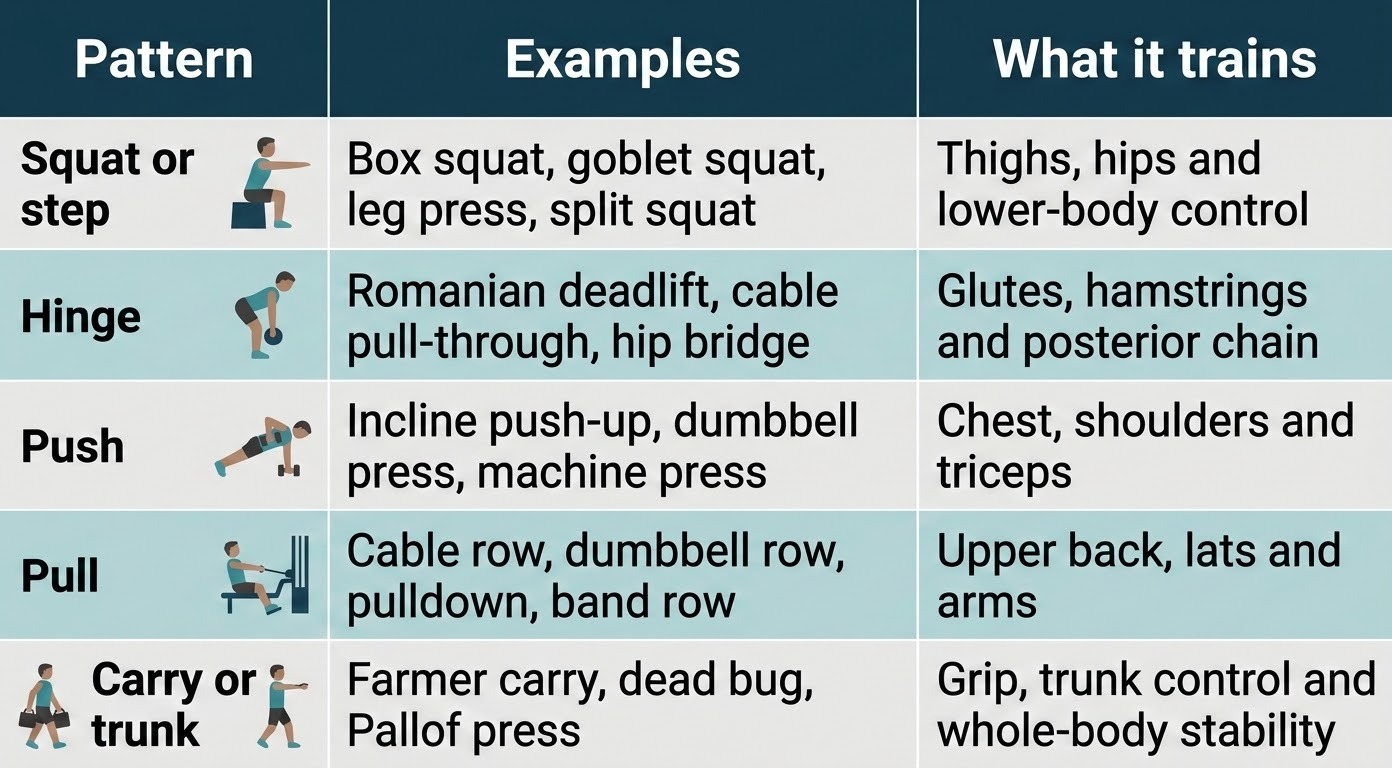
Exercise substitutions are a feature, not a failure. If a barbell squat bothers your knees or shoulders, a box squat, leg press, or supported split squat may let you train the same broad qualities more comfortably. The best choice is the one that matches your body and still allows measurable progression.
A simple weekly structure
- Monday (Full body A): Squat, horizontal push, row, hinge and carry
- Wednesday (Recovery or cardio): Walk, cycle, mobility work or complete rest
- Friday (Full body B): Step or split squat, press, pulldown, bridge and trunk work
- Weekend (Optional third session): Repeat the weaker pattern with lower volume or use recreational activity
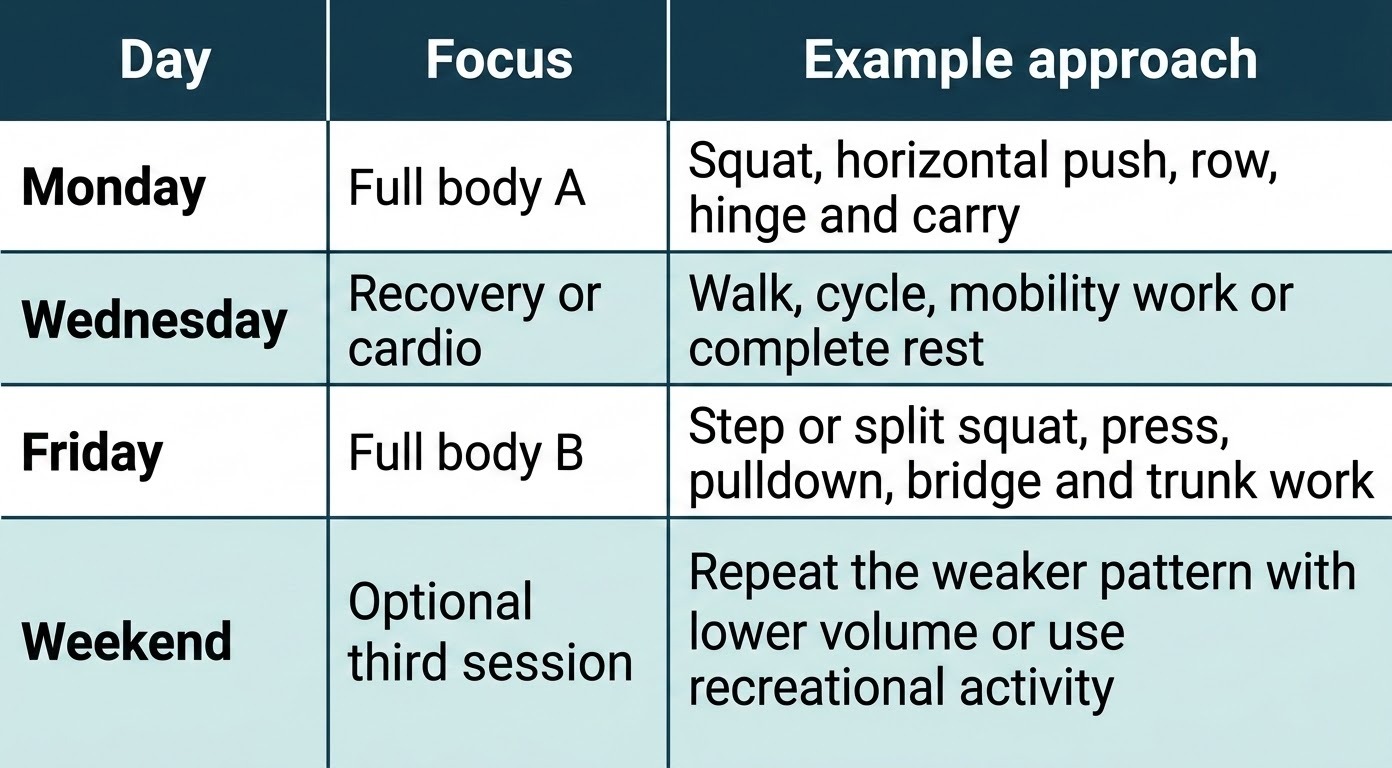
Begin with two working sets per exercise and a repetition range you can control, often 8 to 12 repetitions for many movements. When you can complete the top of the range with consistent technique and a few repetitions still available, increase the load by the smallest practical amount.
Common muscle-building mistakes after 40
- Changing the program every week before any exercise has time to improve.
- Trying to match weights from ten years ago during the first month back.
- Taking every set to failure and treating soreness as proof of a good workout.
- Training only the muscles you can see while neglecting legs, back and pulling strength.
- Ignoring persistent pain, disrupted sleep, or fatigue that keeps getting worse.
- Reducing calories so aggressively that training quality and recovery suffer.
When coaching can help
A coach can shorten the trial-and-error period by selecting exercises that fit your history, teaching technique, and adjusting volume before small problems become long interruptions. Aspire 2 More Fitness offers personalized strength, mobility, and performance coaching in Arvada and Golden, with virtual coaching available for people outside the Denver area.
The Stronger After 40 training module is also in development. Join the waitlist if you want updates, or schedule a Fit Call to discuss a program built around your current starting point.
Frequently asked questions
Can you really build muscle after 40?
Yes. Adults remain responsive to resistance training after 40. The rate of progress varies, but regular training with progressive resistance can improve muscle, strength and function.
How many days a week should I lift after 40?
Two full-body sessions per week are a strong starting point. Many people progress well with two or three days, provided the program covers the major muscle groups and recovery is adequate.
Do I need to lift very heavy weights to gain muscle?
No. A range of loads can build muscle when sets are challenging and technique stays controlled. Heavier work can be useful, but it is not the only path to hypertrophy.
How long does it take to see results?
Performance changes often appear before visible physique changes. Your training history, program, nutrition, sleep and consistency all affect the timeline, so judge progress across months rather than a few workouts.
Keep reading
More practical answers.
You do not need a perfect starting point. You need the right first step.
A free Fit Call to talk through your goals, history and the best way to start.