
Resources / Article
Strength Training With Lower Back Pain After 40 How to Start
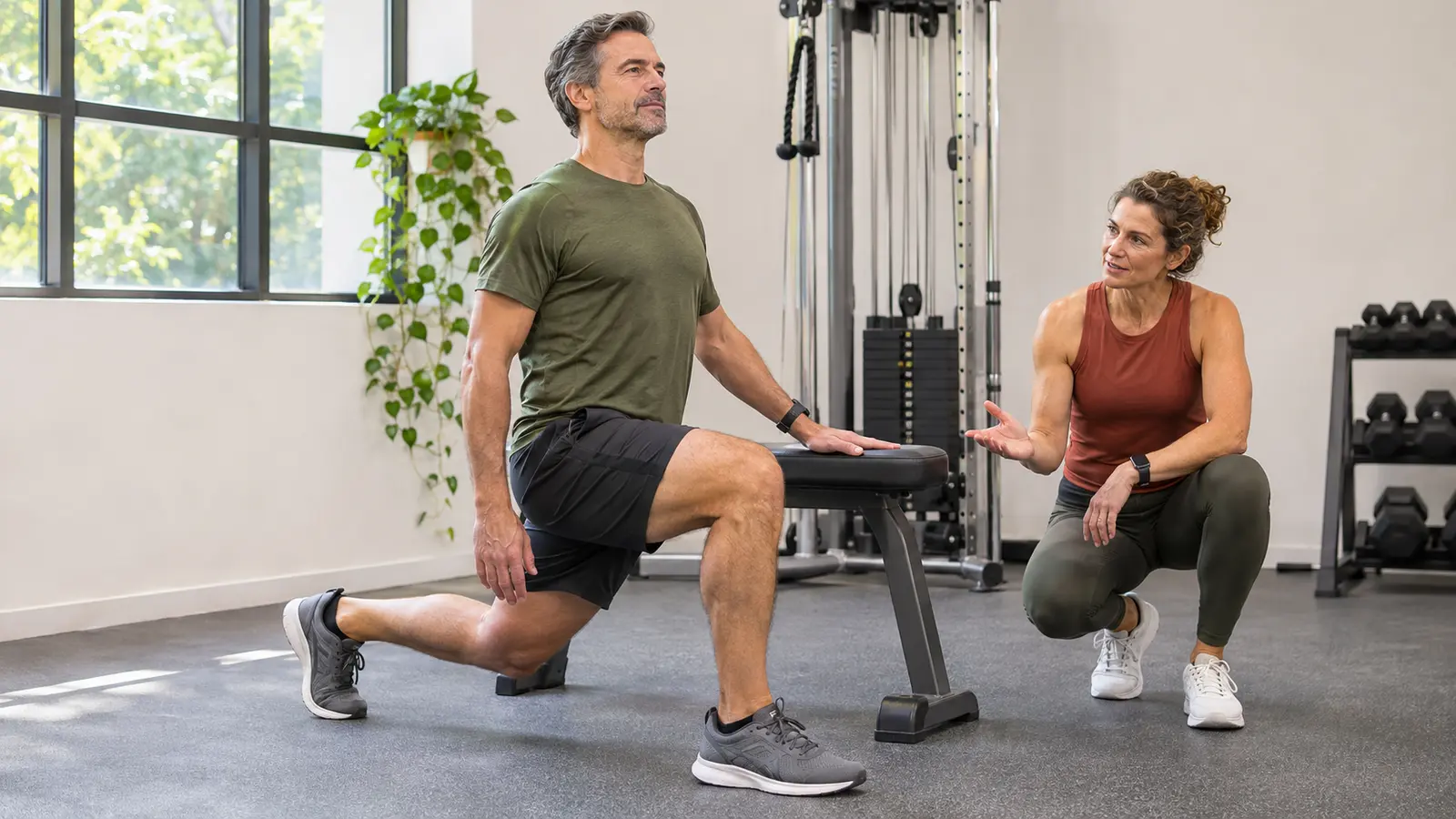
For many people with persistent or nonspecific lower back pain, appropriately selected exercise can be part of a broader care plan. The right starting point depends on the symptoms, the diagnosis when one exists, and how the person responds to movement.
Lower back pain does not always mean you must avoid strength training. It also does not mean every popular back exercise is appropriate for you. The safest useful answer sits between those extremes: get concerning symptoms evaluated, then use a gradual, person-centered plan that can be adjusted based on your response.
This article is general education and cannot diagnose the cause of back pain. A personal trainer can help with exercise selection and technique, but medical diagnosis and rehabilitation belong with qualified healthcare professionals.
When to seek medical care before training
Get prompt medical attention for severe back pain after significant trauma, new bowel or bladder changes, numbness in the saddle area, progressive leg weakness, fever with back pain, or other rapidly worsening neurological symptoms. These signs are uncommon, but they should not be managed with a workout modification.
Schedule an evaluation when pain is new and severe, travels below the knee, repeatedly disrupts sleep, changes your gait, or keeps worsening despite reduced activity. People with a recent surgery, cancer history, osteoporosis, or significant medical conditions may also need individualized guidance before loading the spine.
Why there is no single best exercise for lower back pain
The World Health Organization recommends a person-centered, coordinated approach to chronic primary low back pain. Structured exercise may be included, but it is one part of care rather than a universal cure. Clinical practice guidance also supports several exercise categories, including general exercise, trunk strengthening and endurance, aerobic activity, and movement-control work, depending on the individual.
That breadth matters. One person may tolerate a hip hinge well but dislike prolonged sitting. Another may feel better with supported leg work and walking. The goal is not to find a magical exercise. It is to build a menu of movements that can be performed with acceptable symptoms and progressed over time.
Five ways a strength program can be modified
- Change the exercise. A supported split squat may be more comfortable than a back squat, and a chest-supported row may be easier to control than a bent-over row.
- Reduce the range of motion. A raised deadlift or short-range hip hinge can provide useful practice before a deeper position is introduced.
- Lower the load. A lighter weight can help you learn the movement and observe the symptom response without abandoning resistance entirely.
- Add external support. A rail, bench, cable station, or machine can reduce balance demands and let the target muscles do more of the work.
- Adjust the weekly dose. Fewer sets, shorter sessions, or more recovery days can make the same movement tolerable while capacity is rebuilt.
A back-aware full-body framework
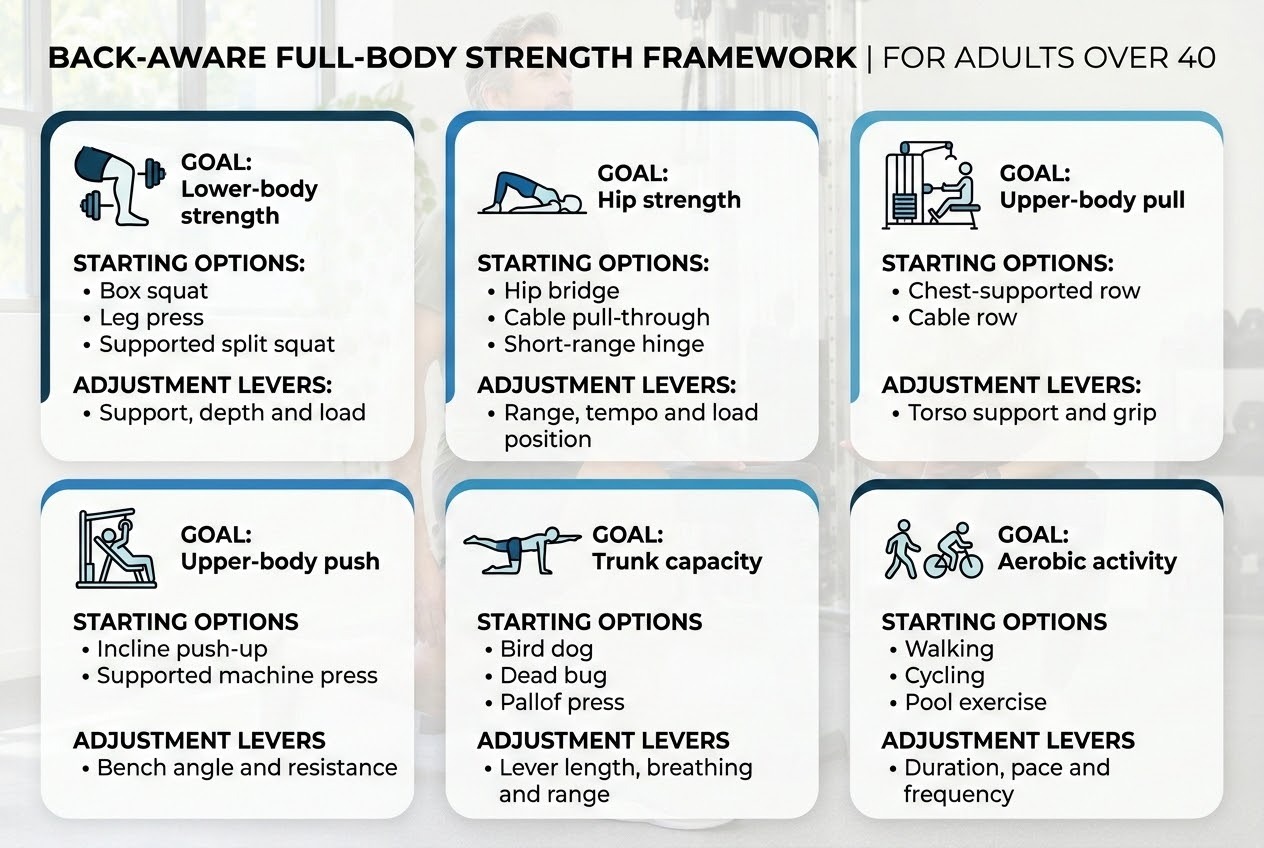
The examples below are options to discuss with a qualified professional, not a rehabilitation protocol. An exercise should be selected because it matches your presentation, not because it appears on a list.
Training framework summary
- Lower-body strength: Box squat, leg press or supported split squat (Adjust support, depth and load)
- Hip strength: Hip bridge, cable pull-through or short-range hinge (Adjust range, tempo and load position)
- Upper-body pull: Chest-supported row or cable row (Adjust torso support and grip)
- Upper-body push: Incline push-up or supported machine press (Adjust bench angle and resistance)
- Trunk capacity: Bird dog, dead bug or Pallof press (Adjust lever length, breathing and range)
- Aerobic activity: Walking, cycling or pool exercise (Adjust duration, pace and frequency)
Use your symptom response as information
Some discomfort does not automatically mean damage, particularly with persistent pain, but the response should remain manageable and predictable. A useful plan monitors what happens during the exercise, later that day, and the following day.
- Continue when symptoms stay mild, technique remains steady, and you return to baseline as expected.
- Modify the range, load, or exercise when discomfort builds set after set or changes your movement.
- Stop and seek clinical guidance when pain begins to radiate, numbness or weakness appears, or symptoms escalate significantly.
- Share patterns with your physical therapist, physician, or other clinician so training and care can stay coordinated.
What a trainer can and cannot do
A trainer can teach lifting technique, provide appropriate regressions, track workload, and help you regain confidence with exercise. A trainer should not diagnose a disc injury, promise to fix your back, or tell you to ignore medical advice. Good coaching respects that boundary and communicates with your healthcare team when appropriate.
Aspire 2 More Fitness can help adults in Arvada, Golden, and the Denver area return to whole-body strength after appropriate evaluation. The Back-Friendly Strength module is coming soon. Join the waitlist for updates, or schedule a Fit Call to discuss whether personal training fits your next step.
Frequently asked questions
Can I lift weights if I have lower back pain?
Many people can continue or return to resistance training with suitable exercise selection and progression. New, severe, radiating, or neurologic symptoms should be evaluated before you train through them.
Are squats and deadlifts bad for the lower back?
Not inherently. They are movement patterns that can be scaled in range, load, support and variation. Whether a specific version is appropriate depends on your symptoms, technique, history and goals.
Should I strengthen my core if my back hurts?
Trunk-strengthening and endurance exercises can be useful for some people, but no single core routine works for every cause of back pain. A broader plan often includes legs, hips, upper body and aerobic activity too.
How do I know whether pain during exercise is acceptable?
There is no universal pain rule. Monitor intensity, whether symptoms spread, whether movement changes, and how quickly you return to baseline. A clinician can help establish limits for your situation.
Keep reading
More practical answers.
You do not need a perfect starting point. You need the right first step.
A free Fit Call to talk through your goals, history and the best way to start.